Brian Mohr · Chicago
Senior Product Designer who ships.
I empathize with users, embed with developers and utilize data-driven processes to evolve products and tie them to a company's bottom line. I built the first design system at the last three companies I've worked for.
Food content is broken. Nutrition advice contradicts itself. All the data is the same.
The Problem
The current AI landscape for online food content retrieves truth from sources that may or may not be correct. GPT, Claude, and similar tools disclaim their errors and walk away. The user is left to fact-check answers that sound authoritative but aren't.
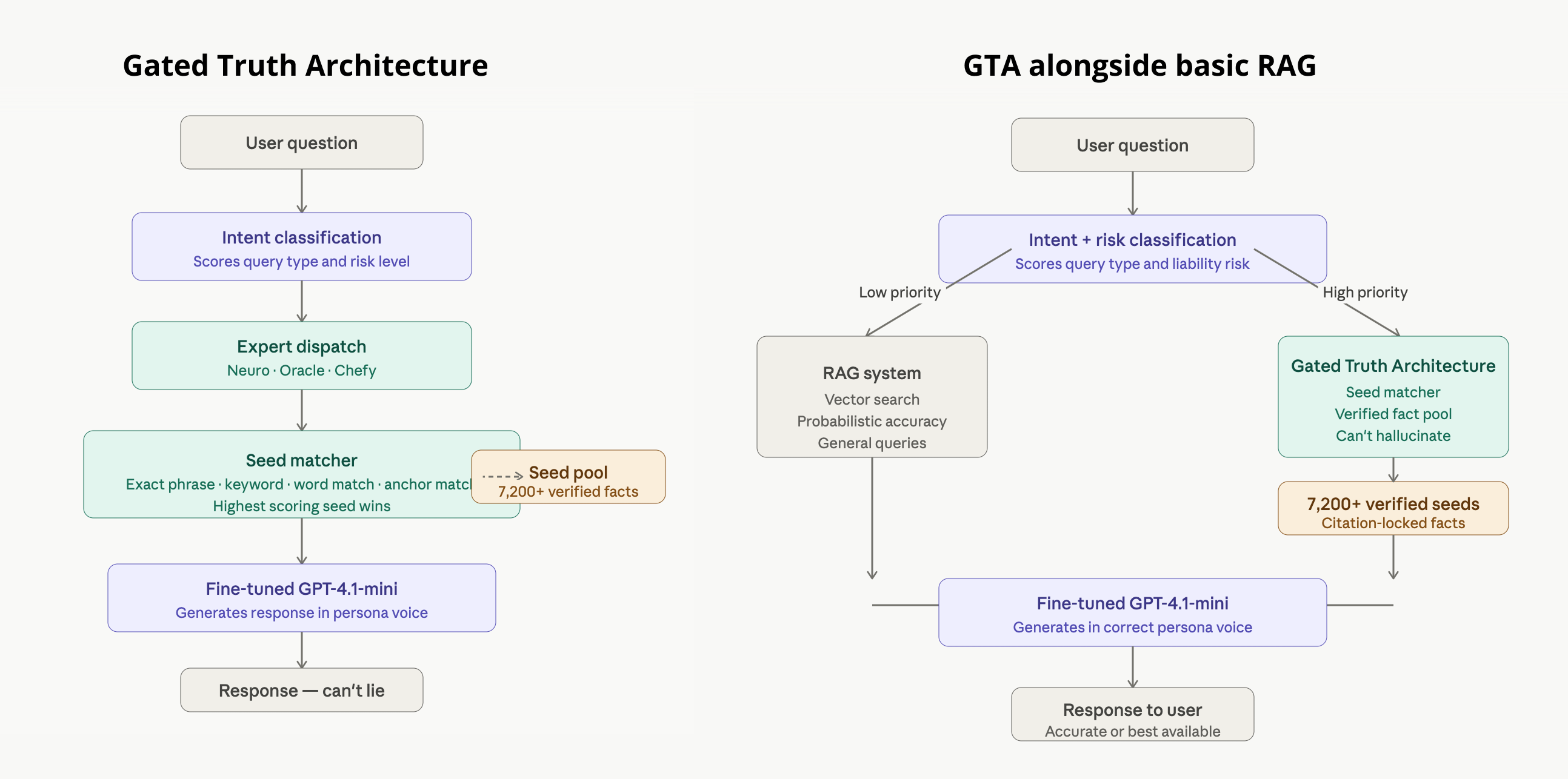
I wanted to build something different: an AI platform that manufactures verified truth instead of retrieving it. Every answer grounded in hand-curated knowledge units, anchors, citations, scoring rubrics, verified before they ever reach a user. I call it Gated Truth Architecture.
The Approach
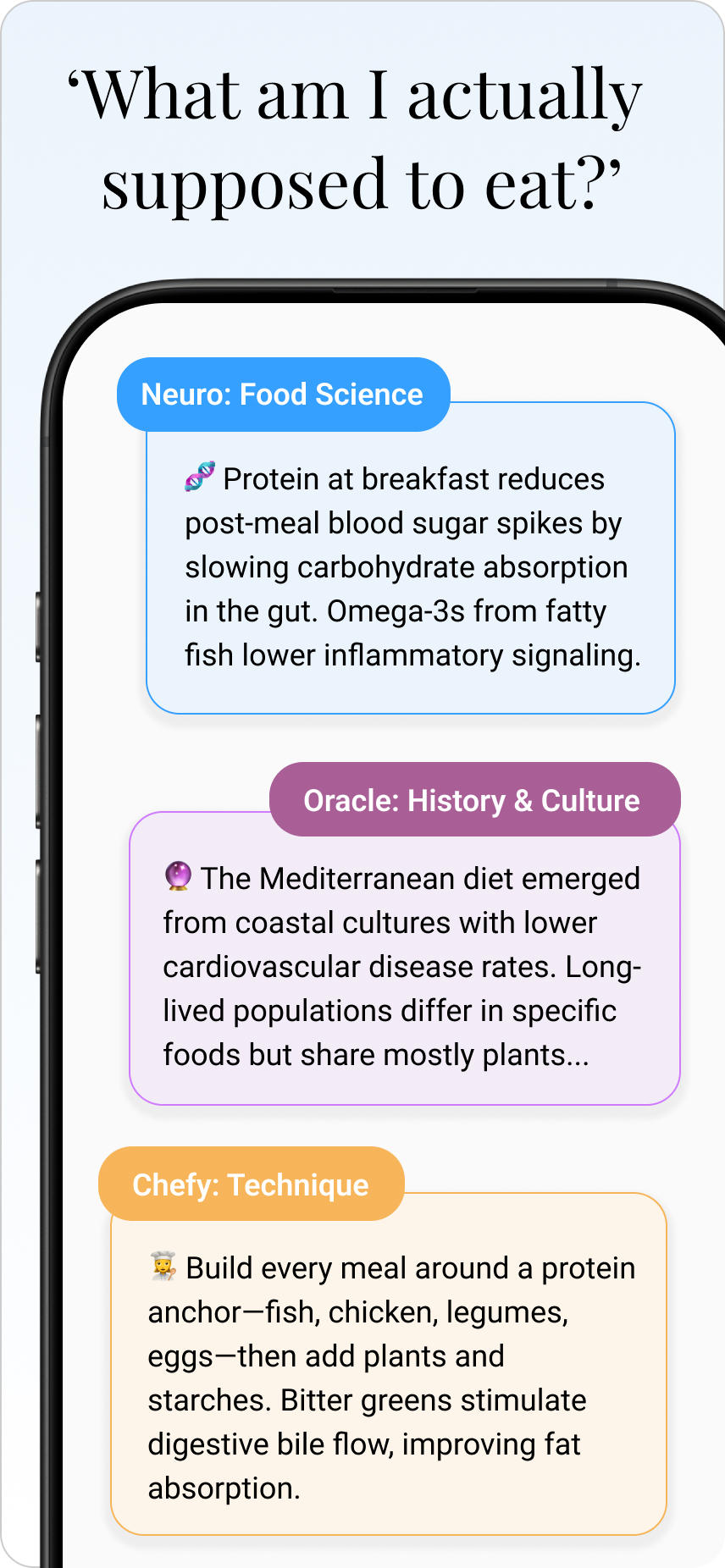
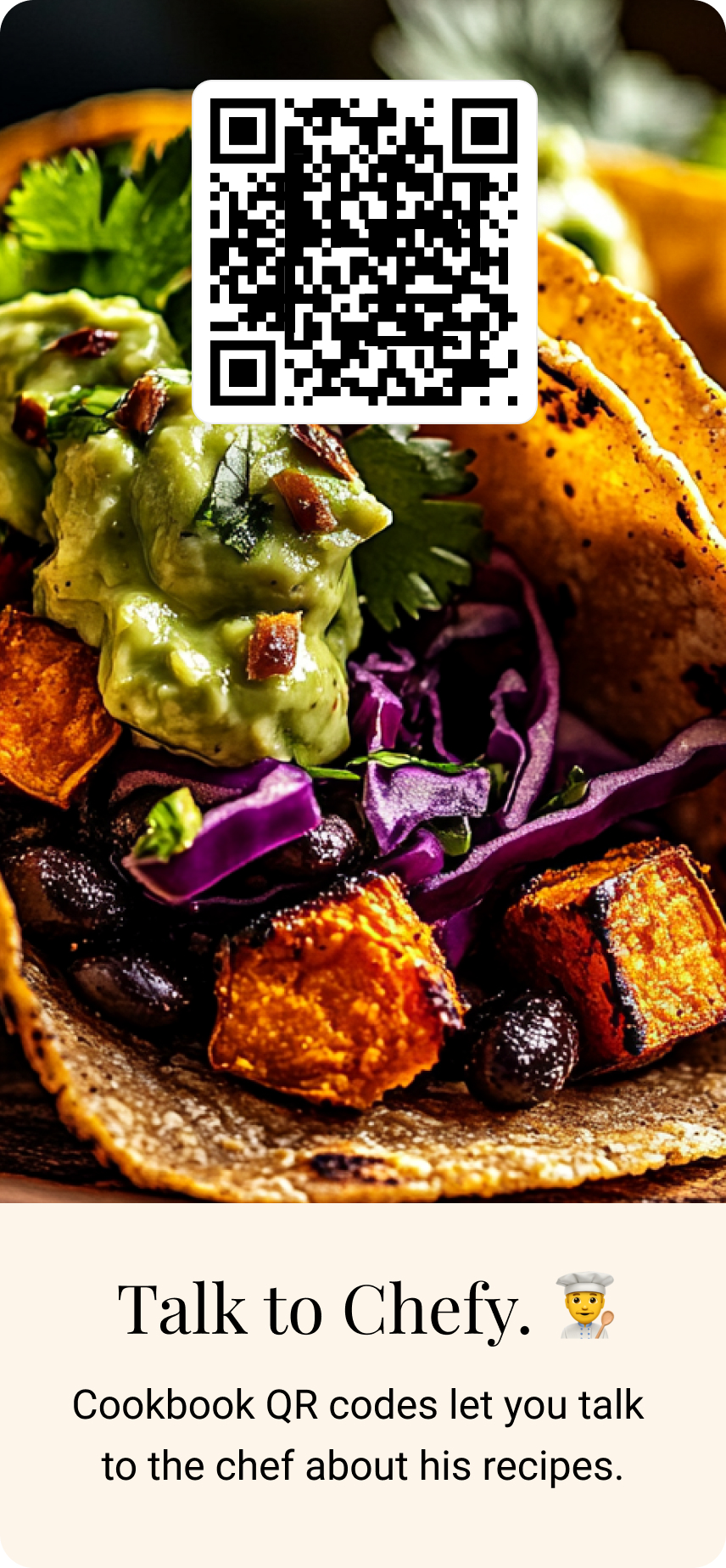
Three expert AI personas, each with a defined scope: Neuro (nutrition science), Oracle (food history and culture), and Chefy (culinary technique). Every response is generated through a fine-tuned GPT-4.1-mini model trained on 10,000+ hand-curated seeds, knowledge units with strict schema, verified citations, and scoring rubrics.
Users ask a question. The system routes it to the right persona, grounds the answer in verified seeds, and delivers a response with traceable sources. No hallucinations. No hedging. No disclaimers that shift the burden back to the user.
The Result
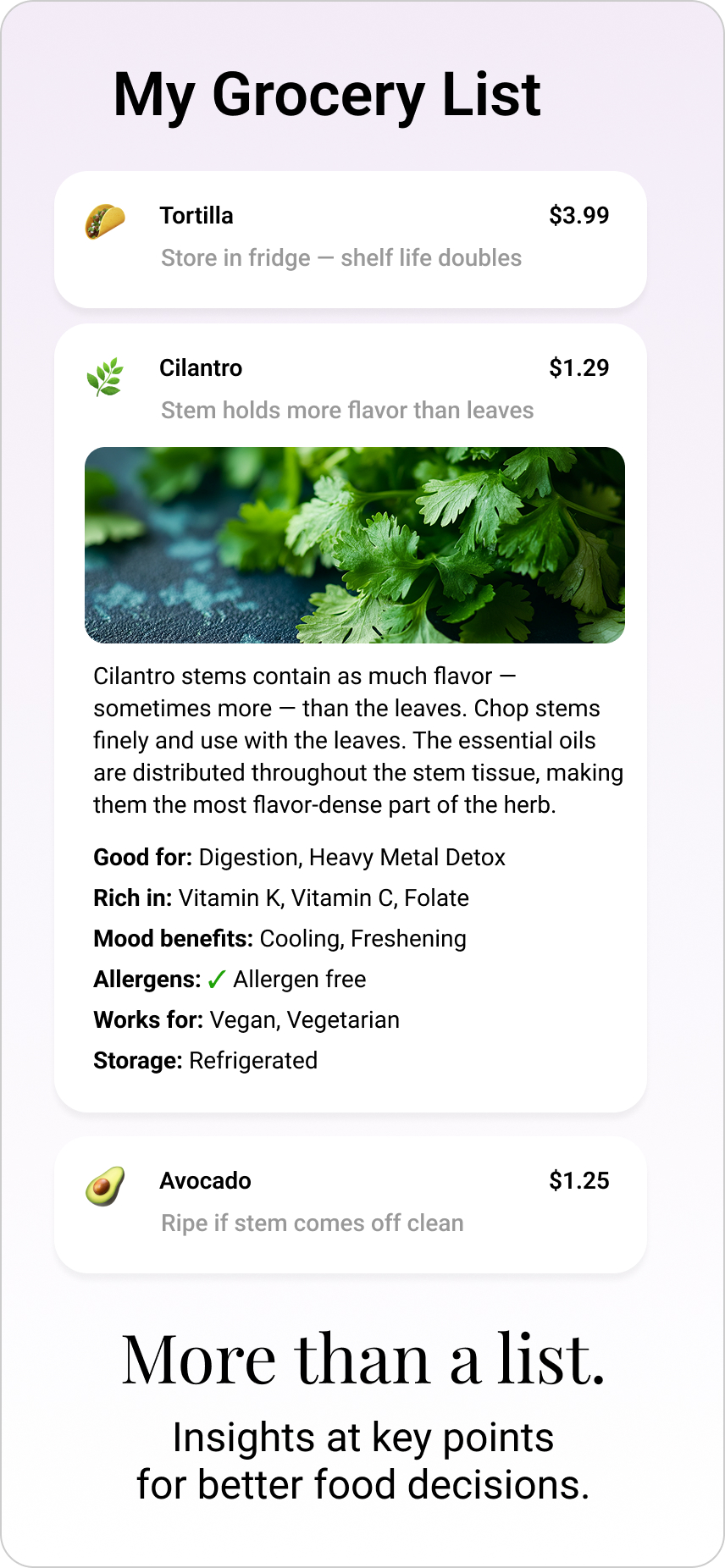
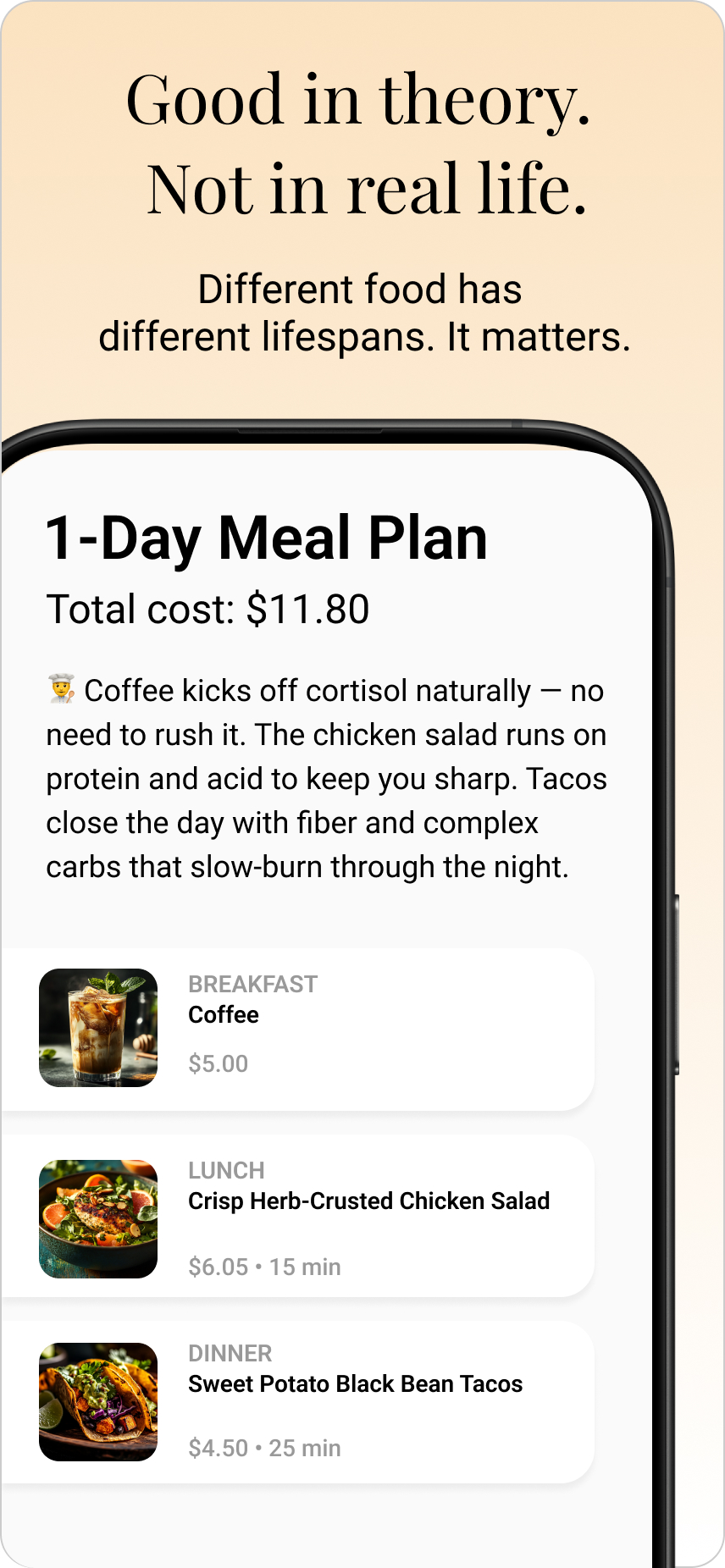
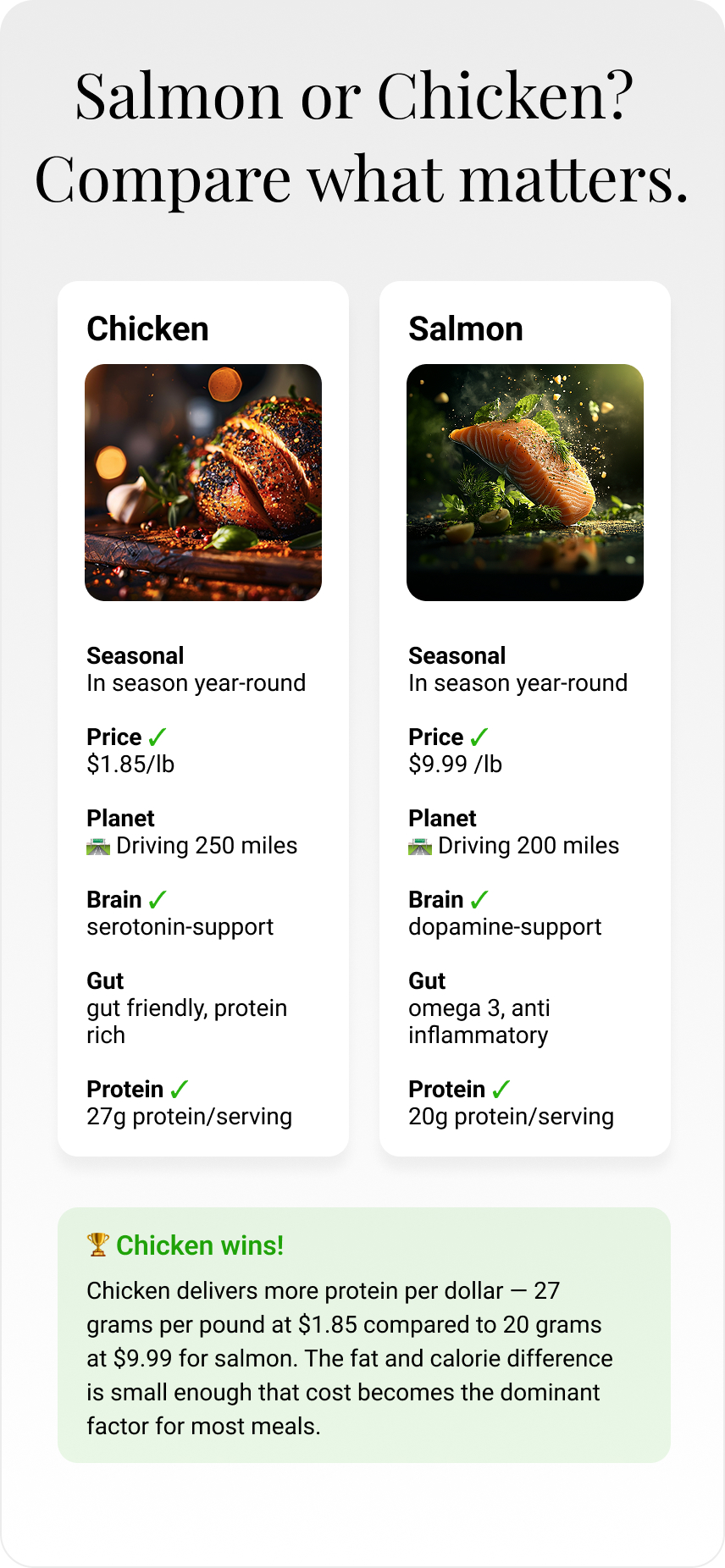
Foodbe launched on the App Store in April 2026. 10,000+ hand-curated seeds, 500+ ingredient profiles, 190+ recipes, a live Developer API with 8 endpoints, and three published cookbooks.



10,000+
hand-curated seeds
500+
ingredient profiles
190+
recipes
8
Brain API endpoints
3
published cookbooks
Fifty years of supply chain software. No design process.
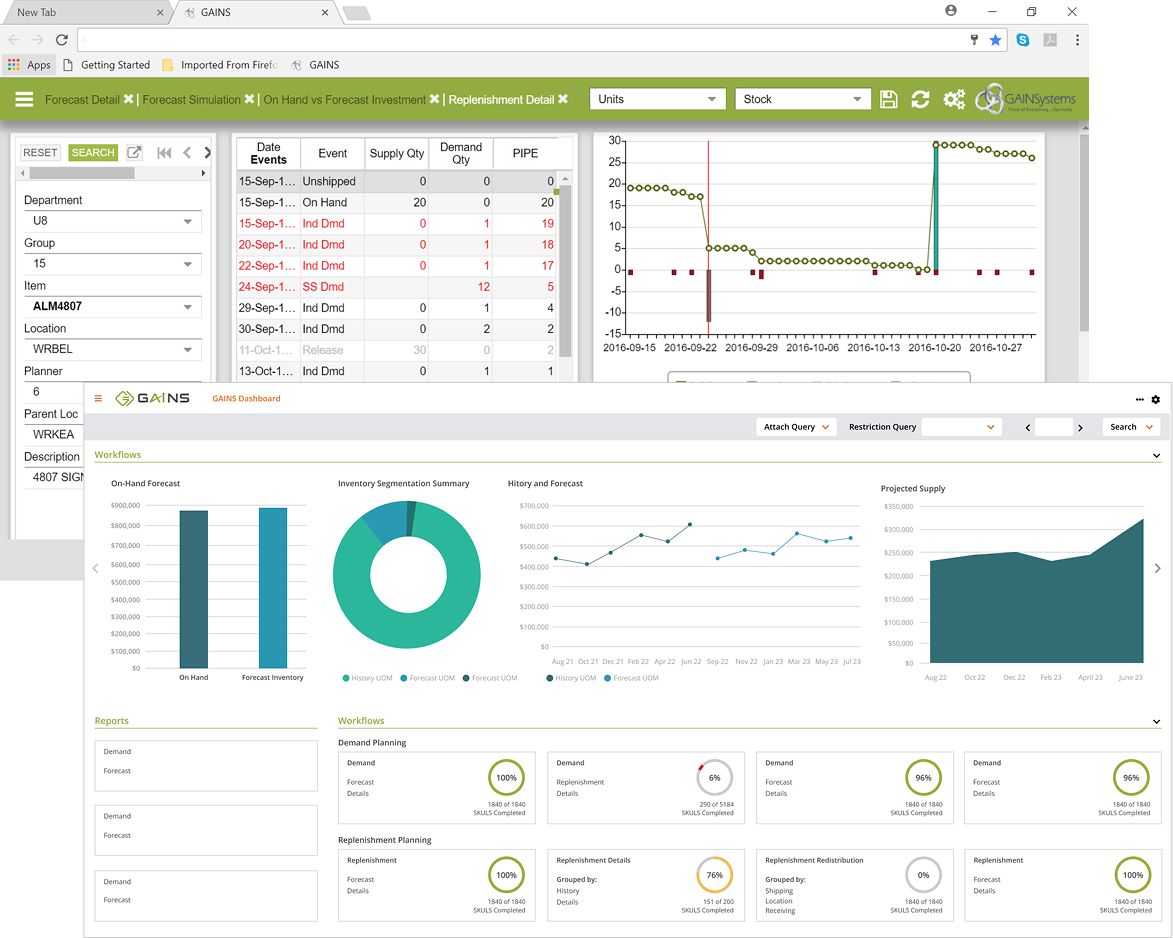
GAINS had been building supply chain software for 50 years and had shipped nine versions of its platform, almost none of them documented. Engineers and consultants would implement whatever a client asked for, directly into the database, without wireframes, user stories, or QA. I was the company's first dedicated product hire.
My role
I led design across the full platform overhaul, working directly with a team of 3 developers and 1 QA, and operated as product lead in daily standups, owning requirements, prioritization, and delivery accountability.
An outside agency had completed an initial user report and produced early mockups before I joined. I took those as a starting point and drove everything from there: research, design system, interaction patterns, and production implementation.
What I designed
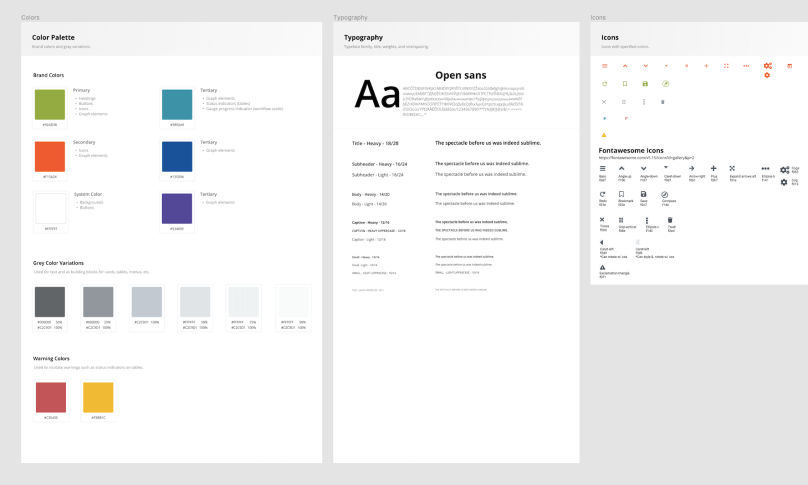
- Design system — full component library, tokens, and patterns in Figma across every surface
- Full platform redesign — forecasting dashboards, inventory planning, supplier management, BI reporting
- Progressive disclosure — expandable sections, collapsible panels, configurable screen layouts
- Search added to navigation and query interfaces
- Icons in dropdowns, cleaner information hierarchy, dark theme
- ADA compliance across the platform
- AI/ML surfaces — Lead Time Prediction and the GAINS Assistant
The research
The most important thing I did early was get outside the building.
I established a monthly customer user group, meeting directly with 20+ users across 10 enterprise client organizations. Qualitative interviews. Usability sessions. Ongoing feedback loops. This became the foundation for every product decision we made.
What we heard consistently: users couldn't configure their screens for the way they actually worked. Half of all users never used the charts or graphs, but had no way to hide them. The interface was built for a superuser who knew every element by memory. Everyone else was left navigating a wall of information they didn't need.
47%
ARR growth in cloud revenue
115%
net customer retention
25+
new enterprise clients
1
Gartner Visionary recognition
Lessons
Great design takes more than great design. It takes organizational alignment. I learned how to navigate competing priorities across leadership, consultants, and engineering, and how to advocate for the user when internal politics pushed in the other direction.
I also learned to get developers genuinely invested in the product. I believe that directly affects the quality of what ships.
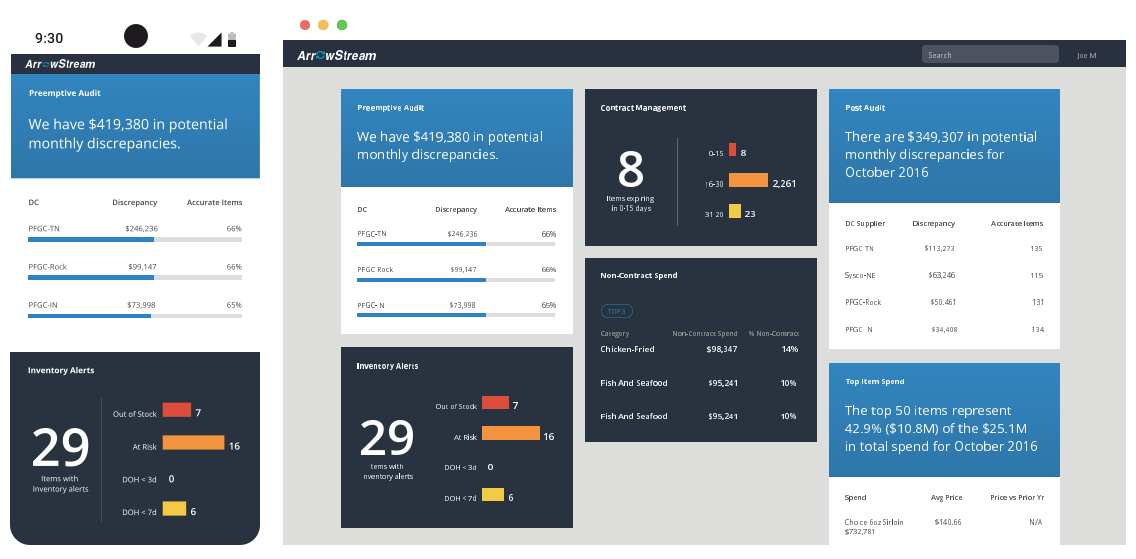
Fewer than 10 clients. No design process. Six years later, $100M+ acquisition.
When I arrived, ArrowStream had about 25 employees, fewer than 10 clients, and was valued at less than $10 million. I was the first dedicated product designer they'd ever had. The tools were disconnected, the interfaces felt like spreadsheets online, and there was almost no technical, user, or requirements documentation to work from.
ArrowStream builds software that allows major food operators, distributors, and manufacturers to manage, analyze, and optimize their supply chains. For years, the industry ran on Excel spreadsheets and fax machines. ArrowStream was bringing it all into a SaaS platform, but the platform looked like it.
My role
I was brought in to build and maintain a design system and then use it to redesign the UX/UI of a B2B complex Supply Chain SaaS platform. I embedded directly in the engineering department, working daily with developers to ensure what was built matched what was designed.
I wrote Bootstrap-based HTML and CSS for frontend templates myself, then handed off to developers, which meant screen layouts came out the way they were designed and reviewed with users. I worked with the PM and BA to document all research, user journeys, requirements, design iterations, and testing across the platform.
What I designed
- Design system: ArrowStream's first, unifying the fragmented suite under a consistent visual language
- Platform unification: tile-driven dashboard with drag-and-drop customization per user
- Cross-app workflow improvements: progress bars, completion states, messaging systems
- Data-heavy screen management: tabs, hide/expand, progressive disclosure
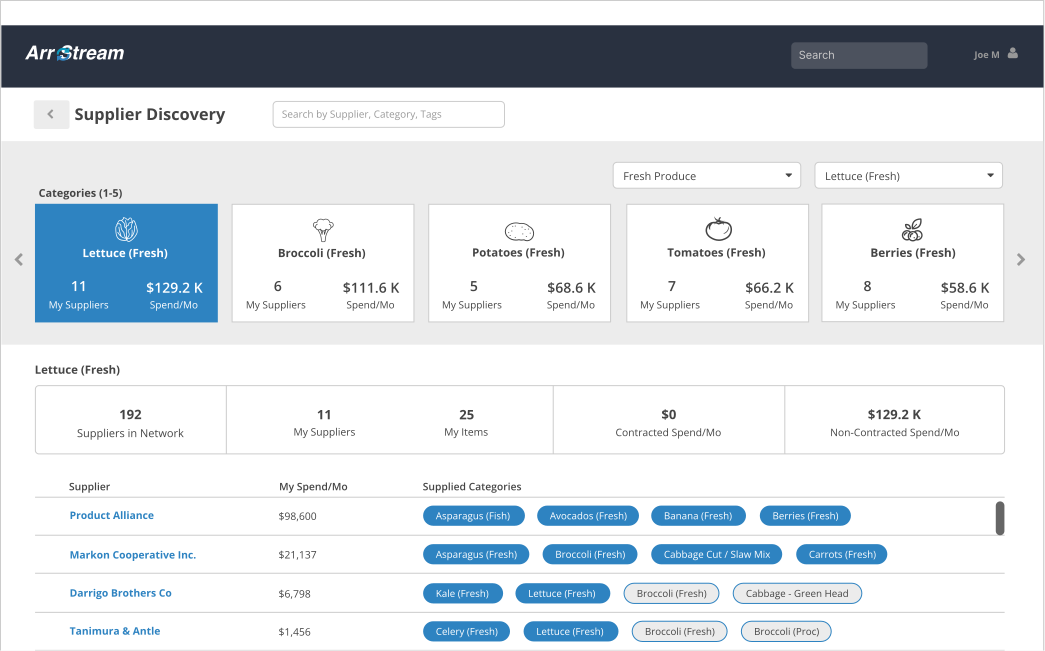
- Supplier Discovery marketplace: RFP creation, new supplier search, A/B tested subscription flow
- QM system, Item Pricing portal, Traceability tool, Strategic Sourcing module
Standout initiative — Supplier Discovery
$5M in buyer savings in the first year.
Buyers and sellers were signing hundreds of contracts a year, but almost always with the same companies. Once a buyer found a supplier they trusted, they rarely looked elsewhere. Part of that was relationship. But part of it was that there had never been an online marketplace where buyers could see pricing from thousands of other suppliers.
I researched the industry, interviewed buyers and sellers, and reviewed usage metrics to find where the opportunity was. Then I architected and designed the Supplier Discovery marketplace, connecting buyers like Shake Shack, Subway, and Dairy Queen to 8,000+ suppliers, with the ability to create RFPs and submit them to new suppliers found through the platform. I ran A/B tests on the marketplace screen with a small user group to optimize the subscription offer and checkout flow.
250+
food companies served at exit
3
private equity acquisitions
$5M
buyer savings in Supplier Discovery year one
130K+
restaurant locations on platform
Lessons
I learned how far early-stage work can travel. I built the first version of Supplier Discovery and it's since grown to 1,600+ distribution locations, 10,000+ suppliers, 250+ brands, and 150,000+ restaurant locations.
With four distinct user segments — restaurant operators, distributors, suppliers, and supply chain managers — too much data was getting buried instead of surfaced. We built an entry dashboard that brought forward the insights each user actually needed, personalized to their role.
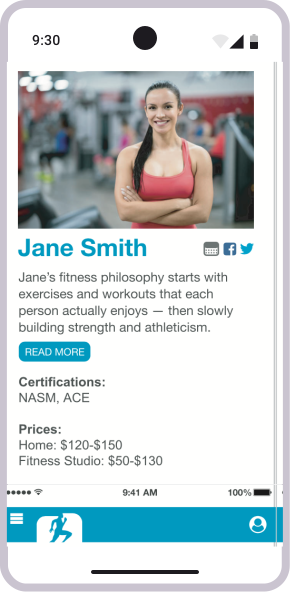
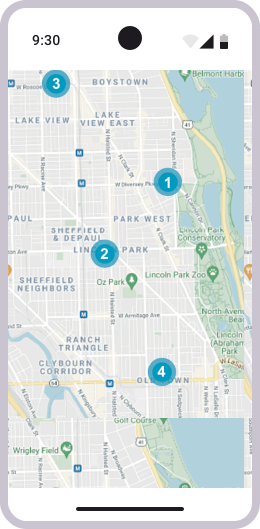
Building a health and fitness platform from the ground up, for the way trainers actually work.
I was the first and only product designer at amSTATZ, a Chicago startup founded to solve a real problem: personal trainers were juggling 4–5 different apps to manage scheduling, billing, and communication, and still losing clients between sessions because there was no good way to stay connected outside the gym.
My role
First hire. I determined the usability and design of the full amSTATZ platform and all digital assets.
I helped establish the software development lifecycle, conducted all user and market research, maintained business requirements and user documentation, designed and iterated prototypes, and worked directly with developers to ensure the frontend matched the final designs pixel for pixel.
What I designed
- Design system: visual language, component library, color palette, typography in Sketch
- Workout tracking: personalized templates, in-session logging, health assessment onboarding
- Scheduling and billing: two-way calendar, drag-and-drop booking, built-in payment processing
- Motivation and communication: alerts, notifications, workout instructions, video links
- Trainer profiles: SEO-optimized public profiles listed on the amSTATZ FitMap
- Dashboard: centralized view for client data, calendars, workout history, session notes
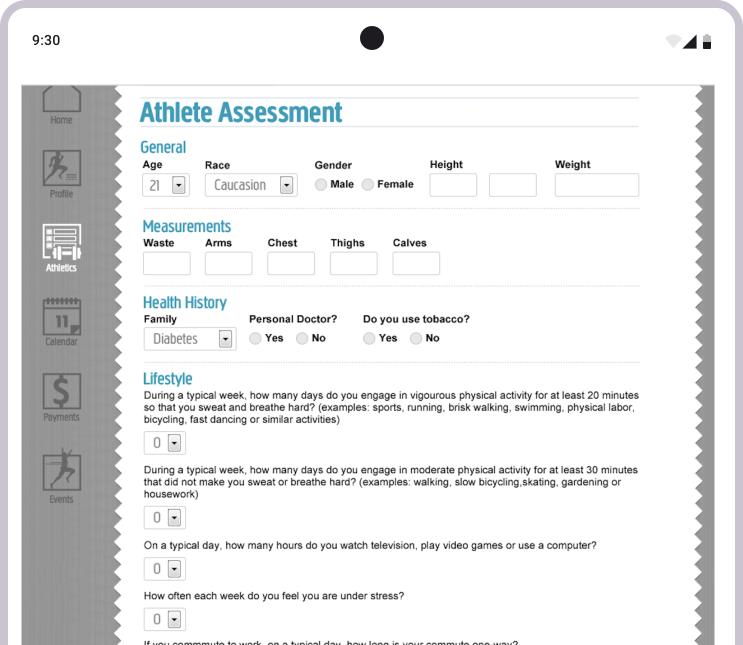
The research
Early work happened in gyms, Lincoln Park and Lake View.
I followed personal trainers through their sessions, watching how they recorded data, communicated with clients, and moved through a workout in tight spaces during peak hours. I worked with a consistent group of three trainers, two women and one man, from early research through mockup reviews and UAT.
Trainers were wasting time they wanted to spend with clients managing their business across multiple apps.
The physical space of a gym, always moving with limited surface area, made large inputs on a phone awkward. Larger phones with large tap targets worked best.
Clients wanted to watch workout videos on a TV at home. A responsive framework was the right call.
1,000
paying subscribers in first 6 months
$1.35M
raised: Launch Capital, LionBird, Indiana Innovation Fund
53,000+
health & fitness professionals via ACE partnership
Lessons
I learned early that every small detail needed to connect back to the overall product, because I'd have to explain it to founders, developers, and users alike. Keeping that micro and macro view simultaneously was what made the work hold together.
I also learned what I'd do differently: I should have spent more time with the lead developer walking through the process, not just handing off designs, but making sure he understood where his team fit in the overall lifecycle so they could stay invested in what they were building, not just in the code.
AI wasn't built to tell the truth. That's not its goal.
Its goal is to pattern-match, to guess the best response to your input. Nowhere in its design is it told to validate from quality sources before it responds. That's a foundational problem.
Even the best RAG system runs at 91% accuracy. That means 1 in 11 answers is wrong. At 500 questions a day, that's ~3,000 wrong answers per month, silently delivered with the same confidence as correct ones.
GTA is different. It gates the AI and only lets it generate a response from a curated, verified fact library, with a human approving every fact before it enters the system. The AI doesn't retrieve, it reasons from facts we know are true.
How the Foodbe brain works
Intent layer
Cleans input, determines intent — how, what, why
Expert routing
Routes to Neuro, Oracle, or Chefy
Seed matcher
Scores 10,000+ seeds using 4 methods — exact phrase, keyword, word, anchor
Fact library
Winning seed's verified anchors passed to fine-tuned model
Response
Model generates answer in persona voice with traceable citations
Download GTA schema PDFA real seed — "Is oat milk healthy?"
{
  label: "Is oat milk healthy?",
  entity: "oat_milk_health",
  thesis: "Oat milk is legitimately healthy because its fiber
    actively lowers cholesterol and fortified versions match
    dairy's calcium. Commercial brands undermine this with
    rapeseed oil and added sugars.",

  neuro_anchors: [
    "beta-glucan forms viscous gels that bind bile acids
     in intestines",
    "liver pulls LDL cholesterol from blood to replace
     bound bile acids",
    "drops LDL ~5-7% at doses of 3g per day"
  ],

  neuro_citations: [
    { text: "beta-glucan LDL reduction ~6.5% meta-analysis
      of 28 RCTs",
      url: "https://pubmed.ncbi.nlm.nih.gov/25411276/" }
  ],

  oracle_anchors: [
    "Oatly co-founded in Sweden in 1994 by Rickard and
     Björn Öste to address lactose intolerance",
    "U.S. dairy industry received over $1.3B in federal
     payments in 2023 while plant milks receive none"
  ],

  chefy_anchors: [
    "froths well for coffee without curdling",
    "works best in recipes where slight sweetness fits"
  ],

  toneGates: { neuro: true, oracle: true, chefy: true }
}
Get in touch
Let's talk.
Available now for senior product designer, founding designer, and AI product roles.
Based in Chicago. Open to local or remote work.